My Bookshelf

Thursday, 8 March 2012

The Tenderness of Wolves

From the back of the book: 1867, Canada. As winter tightens its grip on the isolated settlement of Dove River, a woman steels herself for the journey of a lifetime. A man has been brutally murdered and her seventeen-year-old son has disappeared. The violence has re-opened old wounds and inflamed deep-running tensions in the frontier township - some want to solve the crime; others seek only to exploit it.

To clear her son's name, she has no choice but to follow the tracks leaving the dead man's cabin and head north into the forest and the desolate landscape that lies beyond it...


I have been meaning to read this book for a while, as is the case with so many novels on my shelves... Since I visited Canada myself, both Alberta and Ontario, I have always thought I should read a Canadian novel outside those of the legend that is Margaret Atwood. This book couldn't depict a more raw Canada. Set in 1860s Ontario, Stef Penney describes the impenetrable land, the mysterious indigenous communities, dangerous animals and a brutal murder.


The snow certainly doesn't do anything for shaking Canada's stereotype as a habitable Arctic, but the landscape is really beautifully written, offering some stunning descriptions but without lots of dense paragraphs of description. Penney also creates a really believable rural community with characters you instantly care for. And there are plenty of characters at that... farmer's wives, criminals, magistrates, trackers, foreign tradesmen... Admittedly I got a bit confused at times but, saying that, I liked the community feel to this novel.

It does involve a murder but, for anyone who doesn't like crime books, this is not a crime novel.   Although it isn't fantastical in any way, or even really that scary, this novel has a real haunting atmosphere to it. The winter weather and the wolves on the prowl probably helps but it is also just in its general tone. It has a Brokeback Mountain quietness to it but that's not to say there aren't plenty of twists and turns and satisfying link-ups.


I really liked this novel and found it, overall, very calming: 8/10

Wednesday, 7 March 2012

Canongate Myths

Myths are some of the world's oldest stories and, as you would expect, these tales have been re-written and re-told in tons of different ways over thousands of years. The publisher, Canongate, have latched onto this and started a series some years ago that saw successful writers re-telling some of these well-known tales. Not only do they make great reading, they are good in-between books. By that I mean that they are very short and are perfect for those times when you have a couple of days or even just an afternoon to hand. There are now 14 myths in the series with the most recent being Ragnarok by A.S. Byatt. I, myself, have read 6 now and will definitely be reading more! Here are 4 of my favourites:

Baba Yaga Laid an Egg
 by Dubravka Ugresic
- Baba Yaga Baba is an old hag who lives in a house built on chicken legs and kidnaps small children. It's a terrifying old Russian folktale that I used to love my mum read to me as a child. She has appeared in many different forms over time but is always recognisable. This is a beautiful and fresh reworking of a classic child-snatching myth.


The Good Man Jesus and the Scoundrel Christ by Philip Pullman - I think Pullman had Dan Brown's Da Vinci Code in mind when he branded the back of the book with the words, "This is a story". I'm sure there was no way that this book could have been published without some kind of religious uproar, but Pullman does a fantastic job reworking arguably the world's most famous tale. In it Jesus and Christ are twins and represent the different faces of Jesus: the celebrity and the 'good man'. It's very short, lots of fun and Pullman's writing, as always, is frustratingly good.


Weight by Jeanette Winterson
- This was probably my favourite of all the myths I've read in this series. I'm a big fan of Greek mythology and in this version of the story of Atlas, Jeanette Winterson fully provides. Weight offers a certain mythic quality that I can't quite put my finger on as well as recreating some great characters. Don't worry, though, if you're a fan of Winterson's other work like me, there's a healthy portion of 'strange'.

The Penelopiad by Margaret Atwood - Now everyone loves a bit of Margaret Atwood to read and this is a nice short one for you and, I would argue, probably the most interesting new take on the myths that Canongate done. I say this because Atwood has decided to change the voice of the Odyssey to a woman's - Penelope, the wife of Odysseus. It's a great story and how nice to be able to read it in a couple of hundred of beautifully written but easily read pages!

Click here for a full list.

Tuesday, 6 March 2012

Introducing... John Fowles


"There are only two races on this planet - the intelligent and the stupid."

John Fowles was born and bred in Essex until he was sent off to the highly regarded Bedford School and then Oxford after completing his military service. He would later become a teacher, which took him to what he called "a ratty little school" on the island of Spetsai in Greece. This part of his life would prove extremely influential, as anyone who has read The Magus will know. Despite his career as a teacher, Fowles wrote all his life but it wasn't until the success of his novel, The Collector, that Fowles gave up teaching for a full-time literary career (now considered somewhat of a luxury by many writers today).
The French Lieutenant's Woman (1969) was probably Fowles' most famous novel. Set on the coast in Lyme Regis, where Fowles himself had a home, the novel centres on a disgraced woman who is surrounded by rumours of a past extra-marital affair with a French soldier. The novel is largely a romance and I did really enjoy it - it's a pleasure to read - but it's not simple, famously providing three alternative endings.
The Magus (1966) This is not just one of my favourite John Fowles novels but one of my favourite ever reads. In it, Nicholas Urfe seeks to escape his fractured life in London by taking a teaching job on a small Greek island (sound familiar). Urfe gets more than he bargains for, though, when he meets a master trickster, whose illusions become increasingly dark and frightening. It's just incredibly good.
The Collector (1963) was the first novel Fowles had published. It's shorter than his others and centres around a butterfly collector who becomes obsessed with a young art student and kidnaps her. Although it's not explicit, there's a definite and intelligent unease to this book but it's definitely worth a read.
All three of these novels have been made into successful films but I would say that these are definitely cases where you should read the book first.


"There comes a time in each life like a point of fulcrum. At that time you must accept yourself. It is not anymore what you will become. It is what you are and always will be."

Monday, 5 March 2012

Literary Wiltshire


This weekend I spent some time over in the county of Wiltshire. What a beautiful county, with plenty of rolling green hills and sun-kissed hay wheels (only to be followed quickly by hours of persistent rain...). All of this has provided plenty of inspiration for writers over the years. 

Being prehistoric, it's not surprising that Stonehenge has appeared in literature across history, starting off with the Legend of King Arthur. Merlin was called upon to make a memorial for Arthur's uncle, Ambrosius, who, amongst others, was killed on the Night of the Long Knives. Merlin first came across the stones in Ireland. Known as the Giant's Dance, they were a circle of stones that were believed to give water healing powers. Eventually, Merlin miraculously floated these huge stones on rafts across to England and positioned them in the place where they now stand. Hundreds of years later, Thomas Hardy revisited the stones and used the resplendent setting at the end of his novel, Tess of the D'Urbervilles. Anyone who has read or seen its adaptation will remember well the scene when Tess and Angel stumble across Stonehenge. I won't go any further in terms of the story as would not want to ruin it for anyone who doesn't know, but the scene is as great as its impressive prehistoric setting.

Although the 2008 film was shot at Castle Howard in Yorkshire, it is thought that Brideshead Revisited was set in a large house amongst the county's lush hills, "when the ditches were creamy with meadow-sweet and the air heavy with all the scents of summer".
I'll end there, leaving you with that quote that has me dreaming of summer!

Saturday, 3 March 2012

Book Club: The Group

From the back of the book: The Group follows eight graduates from exclusive Vassar College as they find love and heartbreak, and choose careers and husbands against the backdrop of 1930s New York.

'Focussing on a group of New York friends, its open discussion of sex and contraception, careers and motherhood was unprecedented and it can now be seen as the precursor of the women's novel - without The Group there would certainly be no Sex and the City.' Independent


'She's so funny and bitter and clear-sighted and witty that it was a real joy to read.' Marian Keyes


The Group was our second book club read, following The Interpretation of Murder. Like Rubenfeld, Mary McCarthy offers an old New York City. The glitz and glamour of the 1930s hits Manhattan but the aftermath of the Great Depression and the gradually increasing chances of a second war in Europe does its best to overshadow it.

Despite McCarthy doing a great job of setting the time and place, the best thing about this book is the fact that the concerns of the young women at the centre of the novel are the same as they would be today. The Carrie Bradsaws and the Miranda Hobbs of the 1930s still talked about being terrible mothers, not finding Mr Right, whether to have sex with Mr Nearly-Right and having enough money to buy the coat that is far too expensive. There's plenty of humour in this book and the group's dynamic is, I thought, very believable.

That aside, though, I think we did all feel a bit cheated at the book club. It was sold to us, courtesy of Candace Bushnell's introduction and a couple of quotes on the back of the book, as the original Sex and the City and, in terms of subject, it is. However, the whole book's tone was different and the constant time-changes made it, at times, difficult to follow. The characters were believable, yes, but sometimes we felt that just as you'd started to feel some kind of affection for one character, you'd be back in time talking about a new one who you cared nothing about. There's also a slightly darker feel to this book; something that goes beyond a simple drunken argument with the boyfriend.

All in all, it's a great snapshot of 1930s NYC and young culture. It obviously was original upon publication in terms of its frank discussion of sex and women's issues but I fear that we have become so used to seeing sex and taboo subjects, that it just doesn't quite have the same effect.

We ended up giving it an average of 6/10

Wednesday, 29 February 2012

Judge a book by its cover?

This week's Stylist was one of those best kind of surprises: the awesome but unexpected kind. This week is Stylist's literary week and the magazine is appropriately stuffed full of bookish things - from Gatsby fashion to Kindle debates, from book clubs to bookshelves. I'm not about to steal its content though because you can have a look right here: http://www.stylist.co.uk/in-this-weeks-issue/


Instead, I've used it as inspiration and for that I didn't need to look any further than its front cover. "Judge a book by its cover". This phrase is one known all over the world and used in ways that have absolutely no relation to books and its nearly always considered a bad thing. The thing is, everyone does it! One of the best things about working in the book industry is realising that you aren't the only one doing it... and guess what... the publishers know you're doing it too.

At our last book club meeting it was announced that we would read Arundhati Roy's
God of Small Things. Regardless of the book itself, I can't explain my disappointment when I found out that there was only one edition available and that the cover was SO disappointing. It looks like one of those covers you get on the academic editions at school.

In publishing, what you want is a cover that is "sexy". Now, please take a moment to applaud my use of the word. I have cringed for much of my first year in the industry because that word keeps coming up and, ironically, as a word, it really couldn't be any less sexy! Anyway... I've rambled. Today I thought I'd take a look at some of my favourite covers.


Atonement - Waterstone's Exclusive


So on the left hand side you have some of my favourite special edition hardbacks. I'm not going to pretend I read them, I don't - far too bulky and I wouldn't want to ruin them. I do like having them, though. In fact I have 3 editions of The Great Gatsby, including a beautiful red and gold one that I received as a present a few years ago.

My copy of Atonement is one of many beautiful modern classics sold exclusively by Waterstones. Some great novels have all been given these beautiful and unique covers including Revolutionary Road by Richard Yates, Restoration by Rose Tremain, The Time Traveller's Wife by Audrey Niffenegger and Birdsong by Sebastian Faulkes.

Now to the paperbacks. I've always been a big fan of Vintage classics and their covers and when I got to do work experience there, I was lucky enough to take home a mountain of them. My shelves are now dotted with bright red spines and beautiful photographic, illustrated and intricately designed covers for some of the world's most celebrated stories. Wuthering Heights is one of my favourites of the Vintage collection. There's something so evocative and crisp about it. The matt covers of the books as well just give it that sleek final touch, which kind of makes me want to eat them...

Now everyone knows the cover for One Day by David Nicholls but all his books have had the same treatment. I hate it when book covers are so busy or 'clever' that it takes you ages to find the title and when you have found it you realise actually that's the author's name, not the title etc etc. This couldn't be further from complicated and I like it that way. Plus I'm a sucker for series...

At the end of the day, in a board room somewhere publishers, production and design teams are coming up with book covers that will make you pick them up off the shelf. The best covers are the ones that don't just reflect the novel but the reader, specifically catering the buyer's aesthetic tastes in order to ensure they pick up a book they will actually enjoy. Sometimes you get put off by covers and you think badly of yourself for judging it so quickly but I think, sometimes, that may not mean the book is bad but that it might be a sign that the book just isn't meant for you! What do you think?

Monday, 27 February 2012

And the winner is...


Unless you're sheltered in some underground cave somewhere in Antarctica, it would be hard for you not to know that it was the 84th Annual Academy Awards last night. Now, strictly speaking, the Oscars are not a celebration of books and I'm not about to persuade you that secretly it really is but books do play their part. One of the most anticipated awards is the Oscar for Adapted Screenplay.
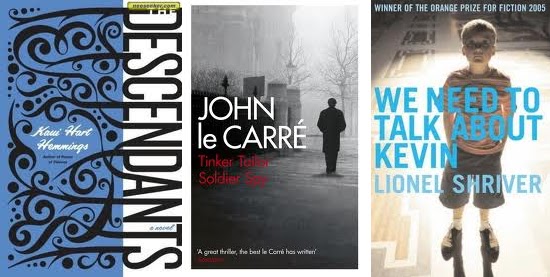
The winner of this year's award went to The Descendants. I have, actually, seen this film, and some of its competitors (Hugo and Tinker Tailor Soldier Spy) but admittedly I haven't read any of the novels. Nevertheless, it did make me ask the question - can there ever be a good Adaptation.
At university I did a module called Literature into Film, where we looked at a handful of classic film adaptations of books ranging from Lolita to Amadeus, from A Room with a View to The Talented Mr Ripley. For my final essay, however, I studied Mrs Dalloway and The Hours by Michael Cunningham and the subsequent film. No reader of this blog will be surprised to learn that my choice stemmed from my fascination with Virginia Woolf but I still struggled with the question of 'good adaptations'.
My belief, and you may disagree, is that you can have a film that perfectly adapts the novel, word by word, in a way that spectacularly recreates the images in your head that the novel originally sparked. This is rare, as everyone's imagination is different, and even when it does happen, it can feel a bit lacklustre because you don't learn or experience anything new. The only times I have truly enjoyed this type of successful adaptation is when I have read the book such a long time ago that I get satisfaction from remembering the story through film.
It is well known that people who read a book before they see the film, are often disappointed as the book is 'always'  better. My personal view is that the more you can mentally separate a novel from its film, the more likely you will enjoy both and, also, protect  your enjoyment of both.
One of the most debated adaptations is the Harry Potter series. I personally enjoyed the books and the films but I think that is because I so rarely consider them as the same thing.
To finish off, I thought I'd list some of my favourite most recent adaptations in the last year:
We Need to Talk About Kevin by Lionel Shriver
The Woman in Black by Susan Hill
The Help by Kathryn Stockett
and some that are due out in the coming months:
Bel Ami by Guy de Maupassant
On the Road by Jack Kerouac
The Great Gatsby by F. Scott Fitzgerald
The Hunger Games by Suzanne Collins