My Bookshelf

Showing posts with label Drama. Show all posts

Monday, 8 September 2014

To Kill a Mockingbird at Regent's Park Open Air Theatre


There is something about the classic coming-of-age story, the bildungsroman, that we just cannot get enough of. Whether it's Charlotte Bronte's brooding Jane Eyre, CS Lewis's magical tales of Narnia, or Suzanne Collins' modern dystopian answer to the genre with The Hunger Games trilogy, the concept is something we can all relate to on one level or another. Whatever age, wherever we live, whatever class we're born into - we can all remember a moment, series of events or time in our lives when childhood seemed to slip from our grip and the murky, less black-and-white (excuse the pun...) adulthood showed itself.

For a friend of mine, Harper Lee's
To Kill a Mockingbird is her absolute favourite example and I can completely see why. For those who don't know, the novel is a touching, loosely biographical tale that follows Scout and her brother Jem as a series of events unfold in their hometown in Alabama during the Great Depression. A young black man is accused of raping a young white woman and their father is the defence lawyer and Scout is suddenly thrown into the town's bitter brawl.

It has since won the Pulitzer Prize and been added to the curriculum in schools all over the world but what do you do when you want to adapt a book that well-read, that well-loved?

The answer, for me, was at the Regent's Park Open Air Theatre this summer and luckily for anyone who missed it - it's going on tour!

Sat in the audience wrapped up in my blanket and hoodie on the sunny but chilly September Sunday evening with my hot chocolate, I won't lie that I was a bit taken aback when a middle-aged woman in a mac and scarf stood up on her chair in the row in front and started speaking to the audience in a distinctly Northern accent, not Deep South America by any stretch.

'Oh god,' I whispered, 'they're going to try and mix it up and set the story in a council estate in Manchester aren't they?' Luckily, I spoke too soon. A few minutes in and the stage comes alive with children and trees and invisible picket fences, the village all cleverly brought to life with some simple props, a few pieces of chalk and a man floating in and out of scenes strumming an atmospheric soundtrack by
Phil King (which, I might add, I bought on CD and is now playing in my car - recommended).

The cast is brilliant, the staging spectacular, and all in all it was the perfect way to spend a late summer evening. My snooty anxiety that 'you can't successfully adapt a truly good book' was put to shame and instead, I've gone away and curled myself up with the novel itself. Success story (pun intended this time) I think you'll agree, and all tied up very nicely with an on-site barbecue dinner and subsequent hot chocolate.

Tuesday, 8 July 2014

Skylight - David Hare


On a bitterly cold London evening, schoolteacher Kyra Hollis receives an unexpected visit from her former lover, Tom Sergeant, a successful and charismatic restaurateur whose wife has recently died. As the evening progresses, the two attempt to rekindle their once passionate relationship only to find themselves locked in a dangerous battle of opposing ideologies and mutual desires.

I am always amazed that theatres are full. Not because theatre is rubbish... but because it has become murderously expensive. I mean, seriously, who has £100 quid to spend on three hours' entertainment?? Thanks, though, to a very generous donor of theatre tokens to the Claire's Cultural Education fund (and some discounted front row tickets), I got to treat myself to Skylight, a play by David Hare at Wyndham's theatre.

I'm a big fan of David Hare - be it his numerous West End triumphs or his Academy Award nominated screenplays for
The Hours and The Reader. Hare alone, therefore, was enough to get me to sacrifice my trusty theatre tokens but when I saw Carey Mulligan and Bill Nighy were going to be in it... well, perhaps disappointingly, I just can't resist a bit of Hollywood.

As it turns out, Nighy is actually reprising the role of Tom that he played back in 1996, in the very same theatre on Charing Cross Road. While I'm perfectly aware that people do get into relationships with a huge age gap, I do find Hollywood's almost insistence of pairing up ageing male actors with beautiful young women gets a bit tiring and is all about the aesthetic and cultural politics and very little about the credible, heart-rending love the writer, I assume, first wrote about. Needless to say, this was
not a problem for Nighy who captivated the audience from the moment he stepped on stage. He delivered the character's charisma and intelligence beautifully and with such energy, you couldn't keep your eyes off him (and he off his audience... it seems Mr. Nighy likes a bit of audience eye contact... while I desperately tried not to shrivel up into a giggly goo ball) and there was no doubt as to why Mulligan's character, Kyra, had fallen for him.

As for Carey Mulligan, her skin really is that good. Turns out she can also multi-task - she admirably acts and cooks in this production. More importantly, she's just the most exquisite actress. Arguably the most touching scene of the whole play is shared between Mulligan and her
An Education co-star Matthew Beard, who play's Tom's son. Beard has clearly been studying his on-screen father's acting style, amazing presence, twitchily charming and bursting with humour.

The play itself is right up my street. Ostensibly Hare showcases the often unhelpful polarisation of society but this is not a political rant, at least I didn't see it that way. Thanks to Hare's hilarious and accurate cultural observations, the play is laugh-out-loud funny (couldn't quite bring myself to type LOL...) while simultaneously building deeper, complex characters. Personally I always love a play or novel that explores a bit of old internal conflict and the lies we all tell ourselves, and Skylight certainly doesn't disappoint as you wait for it all to bubble up through the humour to the surface.

Probably one of the best plays I've ever seen. For me, it felt so real and that's rare for me when it comes to theatre - arguably helped by the neck-breakingly close seats but, if you can snatch a last minute ticket, go. Simples.

Other relevant posts:

Tuesday, 4 February 2014

Wolf Hall at RSC Stratford


When it was announced that Hilary Mantel's Booker-winning Wolf Hall and Bring Up the Bodies were going to be adapted into a stage production by the Royal Shakespeare Company, there was never a doubt in my mind that it would be brilliantly done. Mantel's intelligent and vivid re-imagining of Thomas Cromwell and Henry VIII's Tudor court was made for the stage.

The only thing was that the books were
so long, weren't they? and I'm not sure we could call them the lightest reads either... so the plays were bound to be hideously long and a little 'heavy'. I wasn't convinced the more political side would translate that well - potentially a little dry... When I went to see Wolf Hall in Shakespeare's birth-town of Stratford last week, though, I'm pleased to say that I was completely and utterly wrong.

What I should have remembered was when I heard Hilary Mantel reading from
Bring Up the Bodies at the Southbank Centre a couple of years ago. She brought out all the humour in her writing that I had embarrassingly missed somehow when reading it myself. It was clear from the moment the play started that Mantel was written all over the screenplay. Her heavy involvement in the production has resulted in a play that was both clever and accessible, and really very funny from start to finish. Be it Cromwell's crafty wit or his Shakespearean clown-like servant Joseph, the whole Swan Theatre regularly erupted into laughter. One of them so much that they seemed to be quietly dying of a coughing fit in the third row... 

On the subject of the audience, it was a little, umm, predictable shall we say. I'm pretty sure I brought the average age down by about 40 years for starters. Admittedly it was a matinee in the middle of the week in Stratford but I do hope when the plays move to London later in the year that
everyone goes to see it.

The only criticism I had, and to be honest it's more of a question mark than a criticism, was that I felt there could have been a bit more of Cromwell's brutality. Even though one of the main ambitions of Mantel's trilogy is to change our perspective on Cromwell a little bit and imagine him from a different perspective, there is no doubt that Cromwell could be a cruel bully sometimes, whether his actions were understandable or not. I felt that this was slightly underplayed, not absent, but perhaps too subtle in places. Perhaps
Bring Up the Bodies grows this side of his character a bit more. And maybe make him a bit uglier... Ben Miles is very nice on the eye - pretty sure Crommers was not...

Anyway, it's really really good. So go see it. Do it. Go. And if you're really keen and, you know, rich - book
Wolf Hall and Bring Up the Bodies back to back! I wish I had. Historical inaccuracies aside, there really are worse things than a double-bill of Ben Miles...

Other related posts:

Sunday, 15 December 2013

The RSC's Richard II


Richard is King. A monarch ordained by God to lead his people. But he is also a man of very human weakness. A man whose vanity threatens to divide the great houses of England and drag his people into a dynastic civil war that will last 100 years.

I do love Shakespeare, there's some weird loyalty thing still lurking around from my A-Level days or maybe even earlier. I also feel I've worked hard to get to the stage where I can actually appreciate him. Years and years of not understanding a single thing and now when I understand a whole scene without Spark or York Notes to help me, I still feel shamefully gleeful and normally end up whispering to the person next to me 'I toootally just understood that' to which I normally receive a polite smile of the 'there, there' variety.

So last week I was, very luckily, invited to see Richard II at The Barbican. I'd never read or scene the play before, which normally means I end up doing a quick wiki search beforehand to check the rough plot. This time.. I forgot.


Thankfully, though, the RSC are really very good at putting on Shakespeare, who'd have thought it?? No X Factor props or mad dancers, just stripped back as it should be with a few clever set-pieces and lighting to transform the stage from scene to scene. As a result, it's really easy to follow the plot as the play in itself is quite simple.


David Tennant lived up to his great reputation in the title role. On the surface I thought the role was pretty simple, a King seemingly powerful but in reality a bit of a damp squib, but the different levels on which Richard has to connect with the audience is perhaps a little more extensive than I originally gave him credit. Act IV Scene I when Richard is summoned to personally abdicate the crown requires quite a dramatic contrast of humour, nostalgia, naivety, embarrassment, theatricality, sorrow and also fear, and Tennant completely nailed them all. He may not be quite as pretty as Jude Law and the play may not be as famous or as dramatic as Henry V, but David Tennant can sure act and has a considerably better head of hair in this as you can see. Luscious. (sorry Jude, I do still love you)

So in short, before I start rambling off on pretentious tangents, if you were thinking of going to see the RSC's Richard II, and can get yourself some tickets, definitely go. This is the first play in the RSC's new series of Shakespeare's Histories directed by Gregory Doran.

Sunday, 20 October 2013

Punchdrunk: The Drowned Man

Have you ever seen nature inside out? When the sun stands at midday and it's as if the world was going up in flames?
Step into the world of Temple Pictures where the Hollywood studio system meets a forgotten hinterland filled with dreamers who exist at the fringes of the movie industry. Here, celluloid fantasy clings to desperate realism and certainty dissolves into a hallucinatory world.
Inspired by Buchner's fractured masterpiece Woyzeck, this theatrical journey follows its protagonists along the precipice between illusion and reality.


You would be forgiven for thinking wtf does that mean when you read the above blurb for immersive theatre company Punchdrunk's latest spectacle - The Drowned Man. To be honest you would be forgiven for thinking wtf when you get to the end of the entire evening, having absolutely no idea what you just witnessed. But lord this is good.

Call me cynical but normally I'm a little sceptical of people who tell me how much they 'loved' some weird modern arty theatrical performance because I always slightly think they're worried their cool-points will plummet if they say they didn't like it and had no idea what was going on. This time, though, I was intrigued.

For those who don't know, a little summary. Firstly, you all have to put on Venetian-style white masks so that suddenly you become completely anonymous and it's almost impossible to recognise your friends or they you. 
Once inside, the whole building becomes the dark (quite literally) world of Temple Pictures and its surrounding grounds. It is absolutely vast. 

Floor after floor with different sets, secret passageways, characters' private rooms where you can rummage about their papers and diaries etc, while all the time a
ctors run amongst you playing out scenes. One moment you could be watching a romantic moment between two lovers, before you find yourself in a seedy bar with drunken cowboys threatening each other.

How on earth do you even begin to tackle such a huge project. The answer is of course completely up to you. Some choose to follow an individual character who will, inevitably, introduce you to other people, other floors, other sets as they move around the building. Others follow friends. Some people stick to just a couple of floors and never even find the other sets. Personally I went off on my own. Being the nosey person I am, I went off looking for secret passageways, details written in letters inside characters' dressing rooms, watching random scenes as I came across them. It's a voyeur's dream and I have to say it concerned me a little how easily I slipped into this role...

Sadly I didn't come across many secret passageways... clearly I'm not practiced enough at snooping... but I know some people found themselves whisked away by strange actors desperate to make them famous or being chatted up by a discerning young gentleman...

If you keep wondering around you will eventually discover the bar... completely in the 1940s Hollywood style, you get swept up in the glitz and glamour. It is also the only place in the entire building where you can take off your masks and are allowed to talk to people. Having lost my friends I stumbled across the bar, got myself a glass of wine and found myself getting into deep discussion with a completely random man I'd never met before. There's something so brilliant about that. Like when you're a bit tipsy and get into some weird conversation with a strange person but with all the excitement of the setting and again surrounded by actors carrying on in character.
 

The experience is amazing and I would recommend it to anyone but I would give a little advice:

  1. Definitely read the brief outline of the play that they hand out in the queue.
  2. Don't get too het up with working out the story and what each scene is trying to do because inevitably you will come out with no idea what just happened.
  3. For this reason, split up with your friends and then afterwards go for a drink and share your experiences - you can start to then piece together the story a bit more for yourself (or just get really jealous that your friend found a secret passageway through a fridge or trapdoor or some other awesomeness.

Saturday, 28 September 2013

A Doll's House


A Doll's House is a three-act play by Norwegian playwright Henrik Ibsen and looks into the life of a seemingly typical housewife who becomes disillusioned and dissatisfied with her marriage. The play in its current incarnation has received extraordinary reviews from the British press with Hatty Morahan's turn as Ibsen's protagonist, Nora Helmer, has been hailed as a 'once-in-a-lifetime performance'.

I've seen Morahan on stage and television a number of times and she is a fantastic serious actress but for me she often brings a comedic element to each production, and I can never tell if it's intentional... there's just something about her that makes people smile. In this case, and perhaps it was a conscious decision of the director, the subtle comedy worked perfectly. I don't know about anyone else but after years of studying Arthur Miller, Euguene O'Neil and Tennessee Williams, I've got used to a whole lot of bleak and very little laughter when it comes to drama, which is a shame because comedy, when used well, works brilliantly to both provide relief and/or heighten tension.

Although I've read and seen Ibsen before, I've never known much about
A Doll's House and I have to say I loved it. Brilliantly performed, yes, but politically fascinating. I don't want to give away what happens even a little bit but, as everyone has been saying, it's amazing that this play, given its feminist sensibilities, was written in 1879. Simply having a female protagonist must have been controversial and A Doll's House isn't the last time Ibsen does this. Unsurprisingly the play's controversial subject and ending attracted a lot of criticism and outrage with Ibsen being forced to première the play in Germany with an alternative ending due to pressure from his agent and leading actress.

Interestingly, though, Ibsen was adamant that this was not a consciously feminist play, saying in his s
peech at the Festival of the Norwegian Women's Rights League in 1898 that he"must disclaim the honour of having consciously worked for the women's rights movement," as he wrote the play as "the description of humanity [...] without any conscious thought of making propaganda."

On to more important matters, the award for Best Overlooked Performance goes to... the baby. Perfected the cute podgy look, didn't look at all perturbed or utter so muc
h as a whimper - triumph.

Wednesday, 17 April 2013

Shakespeare's Birthday Whirligig

Shakespeare Whirligig

We know when he was baptised and we know when he died but no one knows exactly when Shakespeare was born. That said, we could hardly have let Shakespeare get away with no birthday... everyone needs a birthday... so we just swap them round and party on his deathday instead. Got to love our resourcefulness... even if it is, perhaps, a little morbid. But, with that logic, Tuesday 23rd April this year supposedly marks his 449th birthday and he's still looking pretty good, it has to be said. Sexy earring I think you will agree...

Anyway, to party in style, The Globe Theatre on London's Southbank is throwing some Birthday celebrations. Between noon and 5pm, it's family fun with all of Shakespeare's marvelous worlds coming to life with witches and fairies and spirits floating around. There are to
hourly performances of Shakespeare's most famous supernatural scenes, children's masterclasses in Shakespearean magic (age 6+) as well as the chance to perform on-stage. 

Don't worry adults, no need to steal other people's children in order to celebrate. From 7pm 
there will be performances from Barry and Stuart running still with the same magical theme from the afternoon. There will be comedy from Piff the Magic Dragon and Chris Cox and this is all topped off with the fantastic sounding ‘Birthday Whirligig’ which will feature music from Johnny Flynn who himself acted in the West-end productions of ‘Twelfth Night’ and ‘Richard III’ last year, and The Magic Numbers.

Surely unmissable?


Shakespeare's GlobeShakespeare's Globe21 New Globe Walk
Bankside
London
SE1 9DT
www.shakespearesglobe.com


Sunday, 7 April 2013

Third Finger, Left Hand


Sisters Niamh and Grace haven't spoken in years, but now Niamh is dying and seeking forgiveness. In a final attempt of reconciliation the sisters meet, reliving the turbulence of their upbringing amid the exhilarating sounds of the 1970s Northern Soul scene, but can old wounds be healed before time runs out?

I don't know how many of you were/are CBBC kids - with the wonders that were Byker Grove, Animorphs, Fairly Odd Parents - but I was. So when my sister announces that Imogen Stubbs (RADA graduate, top RSC actress, ex-wife of Trevor Nunn and, most importantly, cast member of CBBC's Big Kids...) was to star in Third Finger, Left Hand, a play we had tickets for on Friday, we got all excited with nostalgia. Especially as the play was being performed in Trafalgar Studios' tiny three-row shoebox theatre.

And 'nostalgia' really is the right word to use I think as this play follows the highs and lows in the relationship of two sisters. Being very close with my own sister, I particularly enjoyed the play's exploration of that relationship - both the funny and the more touching side.

I've got to say it did take me half an hour or so to get into it. There are just two actresses, Stubbs and Amanda Daniels, in the entire play and yet there are three, four times as many characters, which they both drop in and out of when required. As a result, I felt at times it was necessary for the actresses to over-act, and with the elder sister already having a big personality, in that tiny room it became a little much.

Once I got into it, though, I was just astounded by how cleverly and seamlessly the actresses slipped in and out of characters without any costume or set change to aid the alternations. While I didn't find myself drying tears at the end, it was very touching and I really enjoyed it. You just can't go wrong at the Trafalgar Studios so do get yourself tickets for the next season!

Wednesday, 30 January 2013

RSC to stage Wolf Hall


"From the moment I started writing Wolf Hall the characters were fighting to be off the page." ~ Hilary Mantel

I think I may have more posts about Hilary Mantel than any other author... except maybe my fav, Ginny Woolf... but Mantel really is continuing to take the literary world by storm. Not only has it today been announced that she has become the first person to win both the Costa AND the Booker in the same year. The other news? Her Booker-winning Tudor trilogy is to be transformed for the stage by the Royal Shakespeare Company.

The books, which will be performed in two parts, will take to the stage as part of the RSC's 2013 Winter season at The Swan Theatre in Stratford-upon-Avon. Londoners don't worry, though, it looks likely that the plays, if successful, will most likely come to London eventually.

We have been promised some extra material that did not originally feature in the books. Seriously, how is that possible? The books are humungous! Is it just me or do you think that Hilary Mantel's head should be a lot bigger? Like Noddy or something so that all this info that she has researched can fit... what an intellectual force she is.

Mantel has been working closely with RSC artistic director, Gregory Duncan, so that the theatrical language of the time is captured successfully. See how she feels about her books making the leap to the stage in the video above.

Wednesday, 12 December 2012

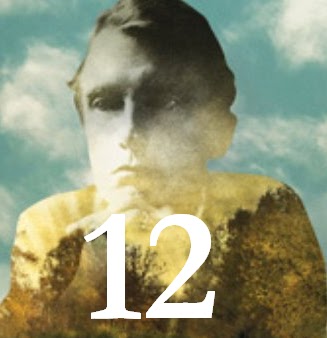
Day 12: The Dark Earth and the Light Sky


"Or must I be content with discontent
As larks and swallows are perhaps with wings?"
The Glory, Edward Thomas

Deep in the Hampshire countryside Edward Thomas scrapes a living; disaffected husband, exhausted father and tormented writer. Then in 1913 he meets American poet Robert Frost and everything changes. As their friendship blossoms Edward writes, emerging from his cocoon of self-doubt into one of the most influential poets of the twentieth century.

On the verge of success he makes the drastic decision to enlist, confounding his friends and family. The Dark Earth and the Light Sky delves into the life of this enigmatic and complex character in an era of change and destruction.

Last night I went along to the Almeida Theatre in Islington to see Nick Dear's The Dark Earth and the Light Sky. When I looked up the description of the play I wasn't entirely sure what to expect. On the one side I thought it might simply be a dramatic biopic, capturing chronologically the short life of Edward Thomas, and showing the ways in which Robert Frost inspired his writing. Then my experience kicked in and thought that so many playwrights can't seem to resist doing something 'clever' or 'artistic' that will in their view in someway get across some kind of deeper meaning.

Ok, so you've probably gathered that I'm not a particularly sophisticated theatre goer, although that doesn't mean I'm not enthusiastic about it. I love the ice cream... the programmes... the merchandise... (damn, knew I should have got that Viva Forever mug...). No, seriously, I love the theatre and even better when you come out and you feel that tiny bit more intelligent... (ok, maybe not with Viva Forever).

I enjoyed this play although I don't feel it was either a biopic nor an overly complex artistic portrayal of Thomas' life. It was very simple, which I appreciated; small cast, clear plot and clever staging. I'm also intrigued by Thomas as a war poet who didn't actually write a poem explicitly about war!

Nick Dear is no stranger to staging literary giants (Frankenstein, Byron, Persuasion, Iris...the list goes on) so it was always going to be good, wasn't it? Plus, I'm a sucker for war stories, I'm half Welsh and an English Lit graduate, and I always love a good biopic.

It's always important to say the acting was spot, although I wouldn't say I particularly liked any of the characters... but they are real people, so it's not like you can just make one of them really romantic or the other really funny if they weren't... Saying that, the humour was great in this. What is ultimately a very sad story was heightened by the carefully placed humour that, as I always say, the Brits do particularly well I think.

My only disappointments really were, firstly, for me, it could have ended at several points in the final half hour. Secondly, I just feel that something was slightly missing... which is harsh to say when I can't put my finger on what. I know it wasn't a history lesson but I don't feel I learnt all that much and I don't feel I invested in a character.

Overall, though, it was a really enjoyable evening and I would recommend going to see it, even if it's just a good excuse to go to a small theatre and witness a great cast take on a literary great that was almost forgotten. 


Tuesday, 13 November 2012

Tape at the Trafalgar Studios


When aspiring filmmaker Jon meets up with his best friend from high school, Vince - a volatile drug-dealing dropout, the conversation turns to Amy, Vince's first love, whom they both dated. Vince finally gets Jon to confess a disturbing secret, only then to reveal he has taped the entire conversation and that Amy is about to arrive any minute...


I've been to the Trafalgar Studios before and so knew the theatre would be small. Being at the very back, despite being in Row C, was a bit cosier than I'd anticipated though... I immediately found myself breaking into sweat - the only possible response to the thought of enforced audience participation. Thank spongebob there was none of that... Slightly anxious moment shared with my mum, though, when we both thought for a horrible second that the two male leads might get naked and sexy and stuff within spitting distance (literally). Over the past few weeks there have been far too many instances where I've had to watch graphic sex scenes with the parents - this would have been the limit...

As you'd imagine, the intimate setting meant that everything was heightened; the tension, the awkwardness, the humour (and the potential nakedness) - you just couldn't miss anything. Unless, that is, you're the woman in the front row who fell asleep within five minutes and whose husband desperately tried to prop up her heavily drooping head as inconspicuously as possible whenever the actors looked their way. His beaming smile desperately trying to compensate for the unmistakable zombie next to him. Genuinely true. Genuinely hilarious.

You'd be forgiven for thinking that this was going to turn out to be some kind of warped panto from seeing the soap-star-studded cast (wow try saying that quickly over and over...). Ok, so there are only three people in this play and the main two are portrayed by Eastenders actor, Syed Masood and Hollyoaks actor Nick O'Connor. They both do a fantastic job, as does Kate Loustau who plays Amy, each bringing something different to the play. Masood, who takes on 'drug-dealing dropout' Vince, provides the unpredictability and humour, the clever mix leaving you always guessing. O'Connor brings the weight, the serious side, and provides what I can only describe with my limited vocabulary as the play's underlying aggression... if that makes any sense... at all. Amy, who doesn't appear until the final third, then shakes everything up entirely when you thought the situation couldn't get any more f***ed up.

It's only an hour and fifteen minutes long and at £19 a ticket, this is a total winner. If you get a chance to see it, do. Something about the play's intensity, and the way playwright Stephen Belber so successfully intertwines humour with tense drama reminded me of Edward Albee's Who's Afraid of Virginia Woolf. What I didn't know was that the play is actually adapted from a film starring Ethan Hawke and Uma Thurman, who knew? But I can't imagine it working any better than in this tiny studio so don't miss a chance to see it either here, or at a local theatre on tour.

Tuesday, 25 September 2012

Pre-Raphaelites and Literature

Ophelia
by John Everett Millais
The Pre-Raphaelite Brotherhood was founded in 1848 by William Holman Hunt, John Everett Millais and Dante Gabriel Rossetti, before being joined by a number of others including Thomas Woolner and William Michael Rossetti. The Brotherhood rejected the mechanistic approach of their contemporaries, perhaps influenced by the changes brought by the industrial revolution, and instead returned to a more complex, detailed and colourful style of painting. 

On Saturday I got to see these inspirations up close at the Pre-Raphaelite exhibition at Tate Britain and it really was a fantastic show. Rooms and rooms of paintings, each with its own theme from religion to nature, paintings to furniture and literature. Of course Rossetti's sister, Christina Rossetti, was herself a talented and well-known poet.

I arrived at the impressive Millbank gallery armed with my trusty English Lit friend from uni, our best thoughtful frowns and our mental Pre-Raphaelite phrase book garnered from the artistic and historical authority that is *coughs* BBC2's drama,
Desperate Romantics (inspired by Franny Moyle's book of the same name). My successful facade was disturbed only slightly when a man whose love for Holman Hunt's Egyptian chair became just too much and saw him sprawl, face down across the varnished floor... 

One of the more frustrating things about being an English Literature graduate is the assumption that you know absolutely everything that is vaguely associated with books. Naturally, I must have read Dickens entire canon and know Hardy's poetry by heart. On Saturday, I instantly noticed Millais' famous painting of Ophelia but then stupidly piled on the pressure by expecting therefore know each and every Shakespearean scene captured by the PRB across the five rooms. Turns out I didn't recognise any - oops. Anyway, having done the necessary reading, here are some of my favourites:

Hamletby Dante Gabriel Rossetti
Two Gentleman of Verona: Valentine rescuing Sylvia from Proteus
by William Holman Hunt
Twelfth Night Act II Scene IV
by Walter Howell Deverell

Friday, 21 September 2012

Mudlarks at the Bush


"It's not like it used to be, you know," she whispered, eyeing up some 'youths' making their way down the Uxbridge Road. "Every time I walk out me 'ouse I think I'm going to be raped," she rasped. "Shepherd's Bush is not friendly any more..." "Is it not?" I ask innocently, while wondering if my silent pleas might see my boss reappear a little quicker. At this point the old woman pushed herself upwards against her frame until she was uncomfortably close to my face. Then, when I thought the situation couldn't get any more awkward, she paused. That deadly device of social witchery. Then: "Don't get too drunk," she spat. Now I know what you're thinking: Shepherd's Bush really knows how to woo a girl.
On my way home, I considered that perhaps playwright Vickie Donoghue had experienced one of these strange but admittedly not all that uncommon conversations herself. Her debut play, Mudlarks, expresses honestly the unsettling reality of youth culture that she has experienced growing up:
On the muddy banks of the River Thames, downstream from the bright lights of London, three boys hide from the police after a night of thrilling recklessness. Over the course of the freezing night their fears, secrets and dreams emerge, collide and combust revealing the desperate frustration of lives barely led but already ravaged.
With the play's gritty honesty comes sadness, with Donoghue particularly dwelling on themes of wasted potential and split allegiances. But, as with so many British plays, Donoghue cleverly weaves in humour that had the audience audibly laughing even at the most depressing points in the plot.
The play isn't subtle, you don't come out wondering what it was all about. I found that kind of refreshing, though, and I was really impressed overall. The acting, the writing, the set were all fantastic and I found myself completely gripped. Would definitely recommend it, but perhaps avoid on celebratory  occasions... amusingly on this particular trip I was tagging along at someone else's birthday present. Not quite the 'larks' that the gift-giver had in mind I don't think!
What made the whole evening even nicer was being able to enjoy the revamped Bush Theatre, which has moved round the corner from the Green and now has loads of places to sit and have a drink/coffee/quiet read throughout the day.
8/10

Friday, 14 September 2012

The Stranger's Child

Blurb: In the late summer of 1913, George Sawle brings his Cambridge friend Cecil Valance, a charismatic young poet, to visit his family home. Filled with intimacies and confusions, the weekend will link the families for ever, having the most lasting impact on George’s sixteen-year-old sister Daphne.

As the decades pass, Daphne and those around her endure startling changes in fortune and circumstance, reputations rise and fall, secrets are revealed and hidden and the events of that long-ago summer become part of a legendary story, told and interpreted in different ways by successive generations. 


Powerful, absorbing and richly comic, The Stranger’s Child is a masterly exploration of English culture, taste and attitudes over a century of change.


I've only read one Alan Hollinghurst and that was his Booker-winning The Line of Beauty (my review for which you can read here). Nestled comfortably in an uncharacteristically warm and sunny Lake District, I fell completely in love with it. As a result, when it was announced that, after seven years, he had written a new book I got all excited. Then I saw the size of The Stranger's Child and thought this slab of cake is going to need time. It wasn't going to be a commuter read, a slightly distracted daily nibble, this was going to be enjoyed, devoured even, and so I decided to wait.


The book was actually published last year (and longlisted for the Man Booker 2011) but my small hands don't much like me insisting that they support a weighty hardback on the train, and so I awaited the paperback. And what a lovely looking paperback it is, don't you think? You've really got to feel it to be honest, all silky and smooth and green and stuff. Call me weird, whatever.


My apologies, I am yet to talk about the story itself. It's one of those generational novels, the kind that spans a chunky amount of time. Love those. Cecil makes his first impression on the Sawles at their home in 1913 and it well and truly sticks. Courting anything that moved, Cecil and his charisma captured the attention of everyone who met him that weekend, be it the naive Daphne, the impressionable George, their suspicious mother.. the list goes on.


Split into five parts, the novel jumps in time at each break. The effect on me was that I had all these questions I wanted answered. What happened to such and such? How did Mr. Blah feel about that? Did Mrs. Whatsherface find out about that? HOW CAN YOU END THAT PART WITHOUT TELLING ME THESE THINGS? and at that point I calmed myself, and started to clap (metaphorically...). Well done Alan (first name terms with the author it seems). You've got me. You have successfully elicited in me exactly what you wanted. Curiosity. The entire novel is an investigation, explicitly so. Most of the answers we either know or find out before the detective (Hollinghurst calls in a couple of new characters to fulfill that role for us), which makes us feel all smart but, more cleverly, makes us understand the source of interest. We completely get why everyone wants to know more about the Valances and the Sawles - because we did too. It's also a playful novel in that way, and very funny.


I sense Hollinghurst puts himself into his books. His sense of humour, certainly. And his experiences of Oxford I am sure inform his writing of the upper classes. His sexuality is in there too. Hollinghurst isn't, I don't think, dropping in gay characters here and there and everywhere because he can, though. He's not trying to make us all go 'OOOOO. HE'S GAY.' In fact I think probably the opposite. But the homosexual themes so frequently surface that I am certain he is making a point. About how things change over time, be it people, reputation, understanding, values and the treatment of homosexuality too.


That may well be my longest review... I apologise. It's a long book. I'm a rambler. Anyway, do go out and read it. I'd lend you mine but it broke... I don't talk about that. It saddens me to think of my fingers desperately clinging to pages 231 and 232 as the sheet desperately tried to escape on a blustery top deck of a ferry...


8.5/10

Tuesday, 21 August 2012

Jumpy


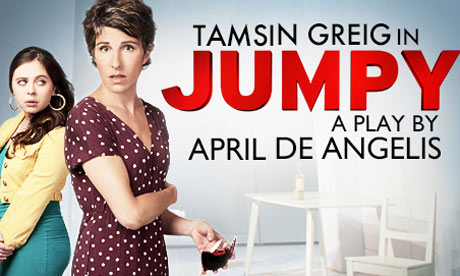
It was a busy weekend for me this week but in all the right ways. A gorgeously sunny music festival, a cinema trip, a big breakfast and some great seats for Jumpy, a play by April de Angelis starring Tamsin Greig.

I'm a big Tamsin Greig fan from watching Green Wing, Love Soup and Black Books but she's done her fair share of stage and 'serious' television too and these two different sides to her team up in Jumpy. In April de Angelis's play directed by Nina Raine, Hilary - a fifty-year-old wife and mother - is battling her on going conflict with her teenage daughter. Bel Powley takes on the role of the argumentative teen in the middle of an adolescent rebellion and does so in style. She completely holds her own on stage with this fantastic cast and you are able to be equally infuriated by and feel affection for her.

It has been billed as a 'frank and funny drama' and that really is the best way to describe it. I suspect you could see this play in very different ways depending on who you are (mother, daughter, father, singleton, married, someone with no children, the list goes on) but you can still all laugh, take comfort, feel touched (or all three!) by the careful observations that De Angelis has written into this production.

All set against a sparse set of mostly white, the characters are entirely on show so nothing goes unmissed. I definitely recommend going to see it if you have a chance. Grieg and Powley are a tour de force... and Doon Mackichan... well, you'll just have to watch it!

Friday, 10 August 2012

Chariots of Fire


I'm aware that this really isn't anything about books but in my brain, for every film and stage production... there's a screenplay and that's like, practically a book really isn't it? Ok I'll stop trying to justify... and just say that last night I went off to see Chariots of Fire on stage and loved it.

Amazingly I ended up with tickets right on the stage. Now, you may think that just means row A or a box, but nonononono. Our seats literally formed the back of the stage so that we were looking out at the rest of the audience, as if we ourselves were the actors. Naturally my sister and I panicked somewhat that we may be spotted yawning at an inopportune moment or inadvertently flash the audience in our summer dresses... 

After the stage fright dispelled, though, we were able to enjoy what felt like a thoroughly interactive stage performance, with actors running in front of us, behind us, around us at full speed to the sound of Vangelis's famous theme. Anyone that's been watching the Olympics this year will know that tune off by heart by now but it really is the perfect choice to elicit those patriotic emotions. Together with the great acting, screenplay and set design, the whole audience found themselves applauding the wins and sighing with disappointment at each loss as if it were a real Olympic stadium.

To receive their applause the cast changed out of their 1924 kit and paraded the stage in the 2012 Team GB sportswear and quite frankly I was pretty jealous. I could do with one of those, I thought. Surely wearing the Olympic kit would make me exercise more. With that kit and Vangelis on my iPod, I'm set for Olympic stardom... see you in 2016!

Friday, 11 May 2012

Two Acts of Kindess

I first came across Terence Rattigan at school. For A-Level English we studied post-1945 drama and the Winslow Boy came up as a practice paper. Reading the dialogue like a novel is never going to do a play justice and I found it, I hate to say, all a little dull... but a 17 year-old can be forgiven for being wrong... right?

As part of the centenary celebrations last year, a new play was commissioned to be performed alongside Rattigan's
The Browning Version at Chichester Theatre. David Hare, himself a modern dramatic genius, subsequently wrote South Downs, inspired by Hare's own experiences at Lancing College in the early 60s. After rave reviews, it was not surprising that the double bill moved to the West End in 2012.

First up
 was South Downs, which follows Blakemore, a teenager boarding at an Anglo-Catholic school in 1962. He is remarkably bright, much to the annoyance of his peers, and finds himself struggling socially. It's a really touching play that culminates in an 'act of kindness' that leaves you feeling all mushy inside!

When my Mum and I talked in the interval, we embarrassingly realised that neither of us knew what play we had just seen and which one was yet to come! When we found out that Rattigan was still to come we let out a little squeal; if
South Downs had been great then The Browning Version was only going to be brilliant.

I have to say my throat felt very dry by the end of
The Browning Version. Andrew Crocker-Harris is a strict and much disliked Classics teacher at an English public boarding school, thought to be inspired by Rattigan's own time at Harrow, but has been forced to give up his long-standing career due to health problems. Crocker-Harris spends much of the first scene off-stage so all you hear what a prat he is. When he appears, however, you slowly come to realise things run a little deeper than that. It's a deeply touching performance from Farrell that reminded me of one of my own teachers.

Anna Chancellor and Nicholas Farrell were pure genius and the young boy who played Blakemore was startlingly good. What I also loved was the accompanying music. No, it wasn't a musical... it's not a load of public schooled boys dancing in unison to catchy tunes in sequined costumes... The piano used between scenes was just a great addition and really helped with the mood.


Anyway, this is a ridiculously long post - I apologise! But go see it - it's one of the best things I've ever seen on stage.